
Most jiu jitsu injuries are preventable, and the people who train for decades are the ones who learn how early.
Almost every adult who walks through our door at Blythewood Jiu Jitsu asks some version of the same question: "Am I going to get hurt?" It's a fair question. Jiu jitsu is a contact sport. You're grappling with a resisting partner, applying joint locks and chokes, and being pinned under someone else's body weight. Pretending there's zero risk would be dishonest.
But here's what years on the mat have taught us: jiu jitsu is far safer than its reputation suggests, and the injuries that do happen tend to follow predictable patterns. There's no punching or kicking to the head. Every submission comes with a built-in off switch — the tap. And the intensity of almost every training round is something you and your partner control.
The students who get hurt usually aren't unlucky. They're rolling too hard, tapping too late, skipping warm-ups, or training through pain they should have listened to. The students who stay healthy for years have built a set of habits. This post lays out those habits so you can start with them on day one.
Where BJJ Injuries Actually Come From
BJJ injuries cluster in a handful of body parts, and each has a recognizable cause. Knowing the pattern is half the prevention.
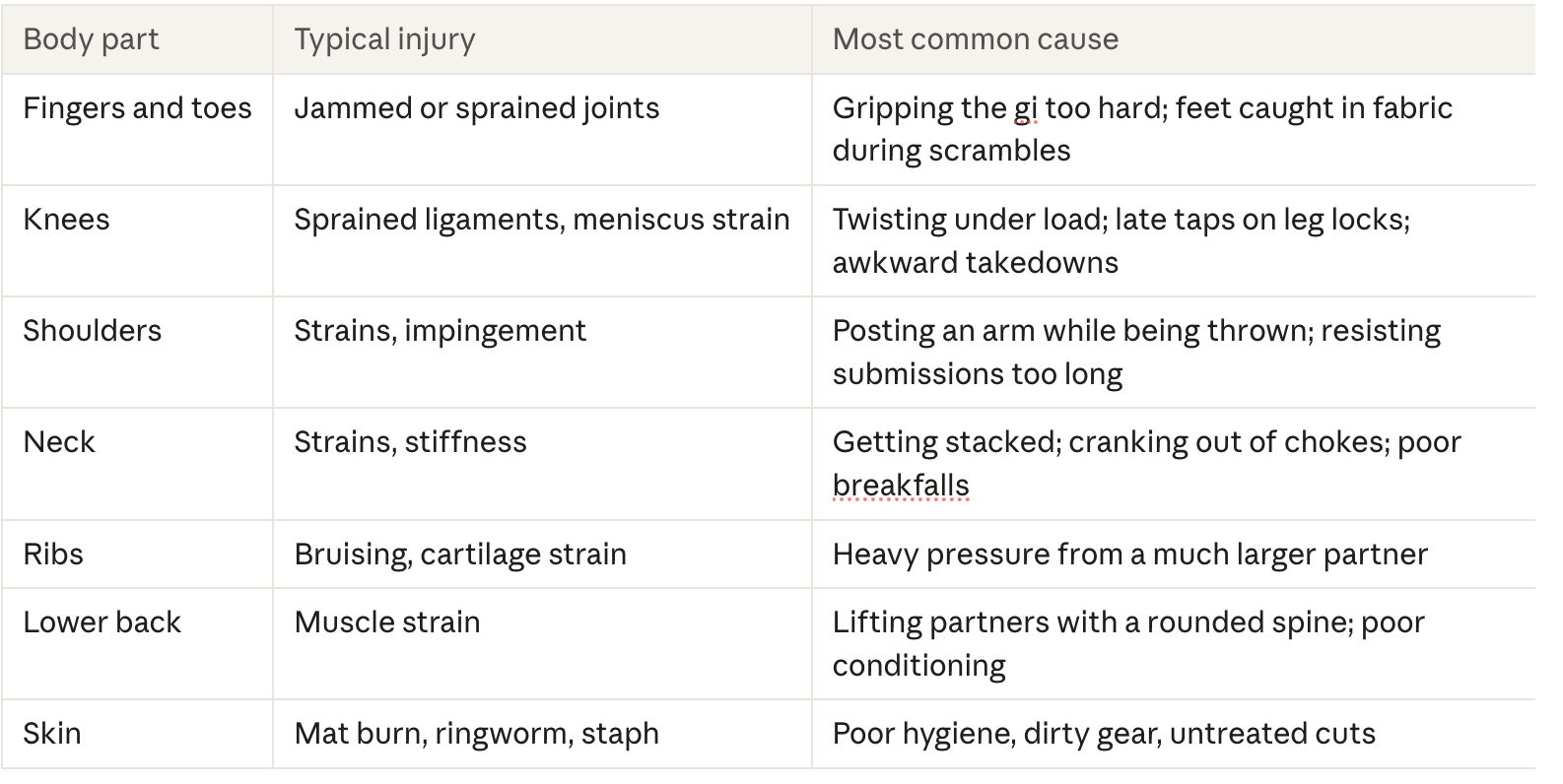
Notice what's missing from that list: very few injuries come from a technique being applied correctly and tapped to on time. Most come from scrambles, ego, fatigue, and unprepared bodies. Those are all things you can manage.
Tap Early, Tap Often
The single most effective injury-prevention tool in jiu jitsu costs nothing: tap sooner than you think you need to.
A joint lock doesn't hurt much until it suddenly does — and by then, the ligament may already be strained. Heel hooks and some shoulder locks are notorious for this. There's often little pain before damage. Chokes are similar: waiting until you're seeing stars is not toughness, it's a gamble.
Don’t forget, some of the more risky Jiu Jitsu techniques are prohibited for white belts, like Heel Hooks.
The tap exists so that you can practice real submissions at full commitment without anyone getting hurt. It only works if you use it. A few rules we teach every new student:
Tap when you recognize you're caught, not when it starts to hurt.
Tap clearly — on your partner, on the mat, or verbally ("tap!") if your hands are trapped.
Release instantly when your partner taps. Every time, even in a scramble.
Don't count taps. Nobody at the gym remembers who tapped whom last Tuesday. Your knee will remember you didn't.
Ego is the biggest injury risk in the room. Getting tapped by a smaller person, a newer person, or someone younger is part of the process. Every black belt you've ever met has tapped thousands of times. That's how they became black belts — and how they stayed healthy enough to get there.
Control Your Intensity and Choose Your Partners
Most of your training should happen at moderate intensity, and you get to choose who you roll with.
New students often assume every roll needs to be a fight to the death. It doesn't. Rolling at 60–70% effort lets you try new techniques, make mistakes, and recover from bad positions without spiking your heart rate or wrenching anything. Save the hard rounds for occasional competition prep, and even then, keep control.
Explosive, spastic movement causes more injuries than any submission. Sudden bridges, wild limb flailing, and yanking a trapped arm free are how partners get kneed in the face or have joints wrenched. Smooth beats fast.
Partner selection matters just as much:
Size gaps matter. Rolling with someone 60 pounds heavier is valuable, but go lighter and communicate.
Ask before you roll. "I'm nursing a sore shoulder, can we go light?" is a normal sentence at any good gym.
Avoid the person who goes 100% every round, especially when you're new. You're allowed to politely decline a roll.
If you think someone is rolling in an unsafe manor, make sure to notify the instructor. At Blythewood Jiu Jitsu, we take partner safety very seriously.
Roll with upper belts. Experienced partners are usually the safest — they control positions and don't need to muscle anything.
Watch the space around you. Many injuries come from collisions with other pairs on a crowded mat. Stop and reset near the wall or another pair.
Protecting the Joints That Take the Most Abuse
Each high-risk body part has one or two habits that prevent most of its injuries.
Knees. Never let your knee get twisted while your foot is planted or trapped. When someone attacks your legs, turn with the pressure instead of against it, and tap early on any leg lock — knee ligaments give very little warning. During takedowns, avoid landing with your leg straight and locked under someone.
Shoulders. Don't post a straight arm on the mat when you're being swept or thrown. It's a reflex, but it's how shoulders and elbows get hurt. Learn to tuck and roll instead. Tap to kimuras and Americanas before the shoulder starts to complain, not after.
Neck. Keep your chin tucked when you fall and when someone tries to stack you. If you're stacked with your weight on your neck, tap or ask your partner to ease up — this isn't a position worth fighting from. Never "bridge" onto the top of your head to escape.
Fingers. Grip fighting is hard on hands. Let go when someone is stripping your grip forcefully, rather than holding on until a finger bends backward. Many longtime grapplers tape their fingers for support, and it's worth learning how.
Lower back. Lift partners with your legs and hips, not by curling your spine. Strong glutes and core muscles do a lot of the protective work here.
Prepare Your Body Before and Between Classes
A prepared body absorbs the stress of grappling; an unprepared one breaks under it.
Never skip the warm-up. Class warm-ups aren't filler. Shrimping, bridging, and rolling drills raise your body temperature and prepare joints for the positions you'll be in. If you arrive late, take five minutes to warm up on the side before jumping into rolls.
Learn to fall. Breakfalls — the controlled way of hitting the mat when you're thrown or swept — are one of the first skills we teach. They spread impact across your back and arms instead of your head, neck, or wrist. Practice them until they're automatic.
Build mobility. Jiu jitsu asks a lot of your hips, shoulders, and thoracic spine. Ten minutes of mobility work a few times a week goes a long way: hip openers, shoulder circles, thoracic rotations, and neck range-of-motion work.
Get stronger. Strength training is injury insurance. Stronger muscles and connective tissue handle awkward positions better. You don't need a complicated program — two short sessions a week built around squats or lunges, hinges, rows, presses, and core work will make a real difference. Neck and grip strength are worth adding too.
Recover Like It's Part of Training
Fatigue causes injuries, so recovery is part of the training plan, not a break from it.
Tired grapplers move sloppily, react slowly, and lose the control that keeps everyone safe. That's why so many injuries happen in the last round of the night. If you're exhausted, it's fine to sit out a round or drill instead of rolling.
Build up gradually. Two or three classes a week is plenty for the first few months. Jumping straight to six a week is a common way to get hurt.
Sleep. Seven to nine hours is when your body repairs the tissue you stressed on the mat.
Hydrate and eat enough. Grappling is demanding, and under-fueled bodies recover slowly.
Take rest days seriously. Soreness from a hard week is normal. Sharp or lingering pain is not.
Listen to small pains before they become big ones. A finger that's sore, a knee that feels "off," a neck that's stiff after rolling — these are signals. Tell your coach and partners, modify your training, and give it time. If pain is sharp, causes swelling, limits motion, or lasts more than a week or two, see a doctor or physical therapist. Training around a small tweak for a week beats being sidelined for three months.
Don't Forget Skin Health
Skin infections are the most overlooked injury in grappling, and good hygiene prevents nearly all of them.
Ringworm, staph, and other skin infections spread through close contact and dirty surfaces. They're unpleasant, they can keep you off the mat for weeks, and they can spread to training partners and family members. The fix is simple:
Shower as soon as possible after training.
Wash your gi, rash guard, and shorts after every class. Never re-wear them.
Keep fingernails and toenails trimmed short.
Cover any cuts or scrapes before class.
Wear sandals off the mat, and never walk on the mat in shoes.
If you notice a suspicious rash or spot, stay off the mat and get it checked.
At BWJJ, we clean our mats regularly. But a clean gym is a team effort — every student's habits matter.
The Gym Matters as Much as You Do
Your habits protect you, but the culture of your gym protects everyone.
A safe gym doesn't have to be a soft one. Some of the toughest grapplers in the world train at academies where injuries are rare. What separates them is how the room is run. Look for:
Coaches who watch the mat during live rounds and step in when a roll gets out of control.
A structured beginner path, so new students learn breakfalls, positions, and safe escapes before full sparring.
Upper belts who take care of newer students rather than hunting them.
Open communication about injuries without anyone being made to feel weak.
Clean mats and clear hygiene rules.
That's the kind of room we work to build at Blythewood Jiu Jitsu. We want you training next month, next year, and ten years from now. The goal isn't to win the roll in front of you. It's to keep showing up.
Train Smart, Train for Life
Jiu jitsu is a lifelong art, and staying healthy is what makes the long game possible.
Tap early. Roll smooth. Warm up, get strong, and rest. Listen to your body, keep your gear clean, and train in a room that looks out for you. Do those things, and the injury question mostly takes care of itself.
The truth is, injuries happen whether or you train Jiu Jitsu or not. You can pull a back muscle picking up something off the ground. You can trip over a curb and roll your ankle. There is a risk of injury while training Jiu Jitsu, but what you learn is how to be active and avoid injuries at the same time. That skill transcends Jiu Jitsu and does in fact help you avoid injuries in every part of life.
If you've been curious about jiu jitsu but worried about getting hurt, come see how we train. Our coaches will walk you through the fundamentals, and you'll never be thrown into a hard roll on your first day.
Book a your first month for $30 at Blythewood Jiu Jitsu.
We're at 733 University Village Drive, Blythewood, SC 29016.
See you on the mats!