
“When is My Next Promotion?”
This is a question every school owner hears at least once a week. Whether it’s the over-eager white belt asking after their third class or the seasoned purple belt wondering why they’ve been "stuck" for three years, the journey through the ranks of Brazilian Jiu-Jitsu (BJJ) is a source of constant fascination and, occasionally, frustration.
In BJJ, the belt isn’t just a piece of dyed cotton; it’s a living record of mat hours, literal sweat, and mental breakthroughs. Unlike many other martial arts where a black belt can be earned in two or three years, BJJ is a marathon.
Here is a comprehensive breakdown of what your students should expect at every stage of the journey.
The Reality of the "Average" Timeline
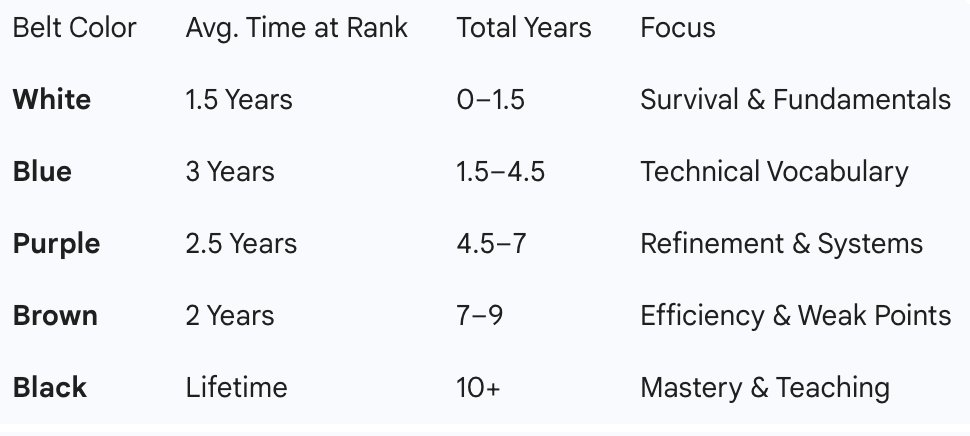
Before diving into the specific belts, it’s important to address the elephant in the room: there is no universal stopwatch. In most reputable schools, the journey from white belt to black belt takes anywhere from 8 to 12 years. To put that in perspective, that’s longer than it takes to become a surgeon.
Factors That Influence Promotion
Consistency: The "3-day-a-week" rule is the gold standard for steady progress.
Previous Grappling Experience: Former wrestlers or Judokas often move through the early ranks faster.
Age and Athleticism: While BJJ is for everyone, a 22-year-old athlete training twice a day will naturally progress differently than a 45-year-old hobbyist with a desk job.
The Instructor’s Philosophy: Some coaches promote based on competition success; others focus on technical knowledge or "mat time."
1. The White Belt: The Survival Phase
Estimated Time: 1 to 2.5 Years
The white belt is the most difficult rank in BJJ—not because of the techniques, but because of the attrition rate. This is where most people quit.
What to Expect:
At this stage, you are a "professional victim." You will spend a lot of time underneath people, feeling claustrophobic and confused. Your goal isn't to win; it's to survive.
Key Milestones for Promotion:
The "Click": Around the 6-month mark, the "static" starts to clear. You stop spazzing and start breathing.
Basic Positional Awareness: You know the difference between Mount, Guard, and Side Control.
Fundamental Escapes: You can reliably escape a headlock or a basic mount from someone your own size.
The Four Stripes: Most schools use a stripe system to track progress. Each stripe usually represents 3–6 months of consistent training.
2. The Blue Belt: The Technical Foundation
Estimated Time: 2 to 4 Years
The blue belt is a major milestone. You are no longer a beginner; you are a practitioner. However, this is also where the "Blue Belt Blues" set in. Many students reach this rank, feel they’ve "learned how to fight," and disappear.
What to Expect:
At blue belt, you start to develop an "A-Game." You find a few sweeps and submissions that actually work on people. You’ll also start to realize just how much you don’t know, which can be humbling.
Key Milestones for Promotion:
Offensive Vocabulary: You have a reliable way to finish fights (Armbars, Triangles, Kimuras).
Defensive Responsibility: You are difficult to submit. Even higher belts have to work to catch you.
Chain Grappling: You stop thinking in single moves and start thinking in sequences (e.g., "If he defends the sweep, I’ll transition to the triangle").
3. The Purple Belt: The Gateway to Mastery
Estimated Time: 2 to 3 Years
Purple belt is often considered the most "fun" rank. You have enough skill to play with white and blue belts, and enough technique to give brown and black belts a hard time.
What to Expect:
This is the "Refinement Phase." You aren't necessarily learning new moves; you are learning how to make your existing moves more efficient. You use less muscle and more leverage.
Key Milestones for Promotion:
Developing a System: You don't just "do Jiu-Jitsu"; you have a specific style (e.g., a "Half-Guard Player" or a "Pressure Passer").
Teaching Ability: You can explain concepts to lower belts clearly.
The "Weight" Factor: You’ve learned how to use your body weight to make yourself feel 50 pounds heavier than you actually are.
4. The Brown Belt: The "Polishing" Phase
Estimated Time: 1 to 2 Years
The brown belt is a black belt in waiting. You are a dangerous grappler with very few "holes" in your game.
What to Expect:
At this stage, the differences between you and a black belt are often subtle—timing, hair-breadth adjustments, and mental composure. You spend this time shoreing up your weakest positions. If you hate playing off your back, brown belt is when you force yourself to stay there until you love it.
Key Milestones for Promotion:
Technical Depth: You know the "why" behind the "how."
Positional Dominance: You can dictate where the roll happens.
Mental Fortitude: You remain calm in deep water and can think your way out of bad spots.
5. The Black Belt: The Beginning of the Real Journey
Estimated Time: 8 to 12+ Total Years
The common saying in BJJ is that a black belt is just a white belt who never quit. Receiving your black belt is a monumental achievement, but most find it’s also a "reset."
What to Expect:
As a black belt, you represent the art. People look to you for leadership and technical mastery. Paradoxically, many black belts say they feel like "beginners again" because they now have the foundation to truly experiment and innovate within the art.
Comparison Table: Average Timelines
Why Is My Promotion Taking So Long?
If you feel like you’ve been at your current rank for too long, remember that the belt is a lagging indicator of your skill. Your skill improves every day you step on the mat, but the belt only changes once every few years. If you focus on the color of the cloth, you’ll get frustrated. If you focus on getting 1% better at your guard pass today, the belts will take care of themselves.
A Note to the Students
Don't rush the process. Being a "bad" blue belt is much harder on the ego than being a "great" white belt. Enjoy the lack of pressure that comes with the lower ranks. Once you put that higher-ranking belt on, everyone in the room—from the hungry white belts to the visiting brown belts—will be coming for you.
Train for the skill, not the status.