
It usually starts the same way. A parent signs their kid up for Jiu Jitsu, drops them off, and settles onto the bench with their phone. A few weeks go by. The parent stops scrolling and starts watching. They notice their kid is learning how to escape from underneath someone bigger, how to stay calm when things get uncomfortable, how to shake hands and say "thank you" after a hard round. And somewhere around week six or seven, the parent leans over to one of our coaches and asks, a little sheepishly: "Do you have a class for adults?"
We do. And some of our favorite people at Blythewood Jiu Jitsu are the ones who made that jump from the bench to the mat.
Training alongside your kid is one of the most underrated things a family can do together. It isn't just another activity to fit into the calendar. It's a shared language, a shared challenge, and a shared community. In this post we'll talk about what parent-and-kid training actually looks like, what it does for your relationship, and how to make the schedule work when everyone is already busy.
The Problem With the Sidelines
Most youth activities are built around a simple arrangement: the kid plays, the parent watches. Soccer, dance, swimming, baseball. There's nothing wrong with that. Cheering from the bleachers is a big part of being a parent, and kids love knowing someone is watching.
But watching has limits. You can see your kid struggle with a skill without understanding why it's hard. You can tell them "good job" after a game without really knowing what went well. And as kids get older, the car ride home often becomes a one-sided interview: "How was practice?" "Fine." "What did you work on?" "Stuff."
When you train too, that conversation changes completely. You know exactly how hard it is to hold a solid guard against someone who's trying to pass. You know what it feels like to be stuck under side control and finally find the escape. Instead of asking "how was practice," you're asking "did you try that elbow-knee escape we learned Tuesday?" And your kid, who normally gives you one-word answers, suddenly has a lot to say.
What Jiu Jitsu Does for the Parent-Child Relationship
You become teammates, not just supervisors
So much of parenting is directing traffic: homework, chores, bedtime, screen time. Those things matter, but they put you in the role of the person in charge. On the mats, the hierarchy flattens out. You're both students. You both bow in, both line up by belt, both listen to the same coach. Your kid gets to see you as a learner, someone who doesn't know everything yet and is working on it.
That's powerful for kids. It shows them that being a beginner isn't embarrassing; it's just where everyone starts.
Your kid gets to teach you something
Here's a moment we see all the time. A parent who has been training for a month gets stuck on a technique, and their nine-year-old, who has been training for a year, walks over and shows them how to fix it. The kid's face in that moment is worth the price of the membership.
Kids rarely get to be the expert in their family. Jiu Jitsu gives them that chance, and it does wonders for their confidence. It also teaches them patience and communication, because explaining a technique to someone else is harder than doing it yourself.
You model the habits you want them to have
We can tell our kids to work hard, stay humble, and keep going when things get tough. But kids learn far more from what we do than from what we say. When your child watches you tap, reset, and try again, when they see you come back the next week after a frustrating class, when they watch you shake hands with the person who just beat you, they're learning what resilience looks like in real life.
And the reverse is true too. It's hard to tell your kid to push through when you're sitting on the bench. It's a lot easier when you're out there doing it with them.
It builds trust through physical connection
As kids grow up, especially into the preteen and teen years, physical closeness with parents naturally fades. Hugs get shorter. Wrestling on the living room floor stops. Jiu Jitsu creates a safe, structured space where that physical connection still exists, with clear rules, mutual respect, and a lot of laughing. Drilling with your kid builds a kind of trust that's hard to find anywhere else: they learn that you'll keep them safe, and that you trust them enough to let them try their techniques on you.
What Parent-and-Kid Training Actually Looks Like
If you're picturing yourself grappling full speed with your seven-year-old, don't worry. That's not how it works.
Families at BWJJ train together in a few different ways:
Separate classes, same schedule. This is the most common setup. Kids attend their age-appropriate class while parents train in the adult class at the same time or right after. Everyone gets instruction designed for their level and body, and the family shares the drive, the routine, and the stories afterward.
Family or open mat time. On open mat days, families can drill together at a pace that works for them. A parent might help their kid review techniques from the week, or the two of them might do light, playful rounds where the parent lets the kid work.
Practice at home. Once you both know the basics, the living room becomes a training space. A few minutes of drilling a technique from class, or reviewing how to fall safely, keeps the learning going between sessions, and it's a lot more fun than another hour of screens.
The key thing to understand is that kids and adults train differently, and they should. Kids' classes are built around games, movement, and short attention spans. Adult classes go deeper into technique and include harder sparring. When parents and kids do share the mat, the parent's job is to be a good partner: controlled, patient, and generous. That's a skill in itself, and it makes you a better training partner for everyone.
"But I'm Not in Shape" and Other Things Parents Tell Us
We hear a lot of hesitations from parents considering the jump. Here are the big ones.
"I'm not in good enough shape." Almost nobody is when they start. Jiu Jitsu gets you in shape; you don't need to get in shape first. Beginner classes are designed for people starting from wherever they are, and you control your own pace. Many of our adult students started training in their thirties, forties, and beyond.
"I'll embarrass myself in front of my kid." You'll be a beginner, and your kid will see that. That's the point. Watching a parent be brave enough to start something new is one of the best lessons you can give them. And trust us: they won't be embarrassed. They'll be proud.
"Isn't it dangerous?" Jiu Jitsu has a built-in safety valve called the tap. Any time someone feels uncomfortable, they tap and their partner lets go immediately. Our coaches put safety first, especially with beginners, and adults new to the sport learn to train at a controlled pace. If injury is a concern, we've written a whole post on training smart for the long haul.
"My kid needs their own thing." This is a fair worry, and it's worth talking to your child about. Some kids love the idea of training with a parent. Others want something that's theirs. The good news is that with separate kids' and adult classes, your child keeps their own space, their own coaches, and their own friends, while still sharing the bigger experience with you. Ask them before you sign up. Most kids say yes faster than you'd expect.
Making the Schedule Work
Let's be honest: the biggest barrier for most families isn't fitness or fear. It's time. Between work, school, homework, and everything else, adding one more thing feels impossible.
This is where family training actually wins. Instead of two separate activities with two separate drives on two separate nights, you have one. Here's how families make it fit:
Stack your classes. Look for days when the kids' class and an adult class run back to back or at the same time. You're already at the gym; you might as well train.
Start with two days a week. Consistency beats intensity. Two classes a week for a year will get you much further than five classes a week for a month before you burn out.
Make it a standing appointment. Treat training like any other commitment on the family calendar. When it's "what we do on Tuesdays and Thursdays," it stops being a negotiation.
Share the load between parents. In two-parent households, some families take turns, with one parent training on certain days and the other on different days, so someone is always on the mat with the kids.
Use the drive. The ride home becomes a built-in time to talk about class, what clicked, what didn't, and what you want to work on next time. It's family time you didn't have to schedule.
When you look at it this way, family training isn't one more thing on the list. It replaces several things: your workout, your kid's activity, and some of that quality time you've been trying to find.
A Family Spotlight
The Hensley Family
Charles (Dad) - Owen (Son) - Ava (Daughter)
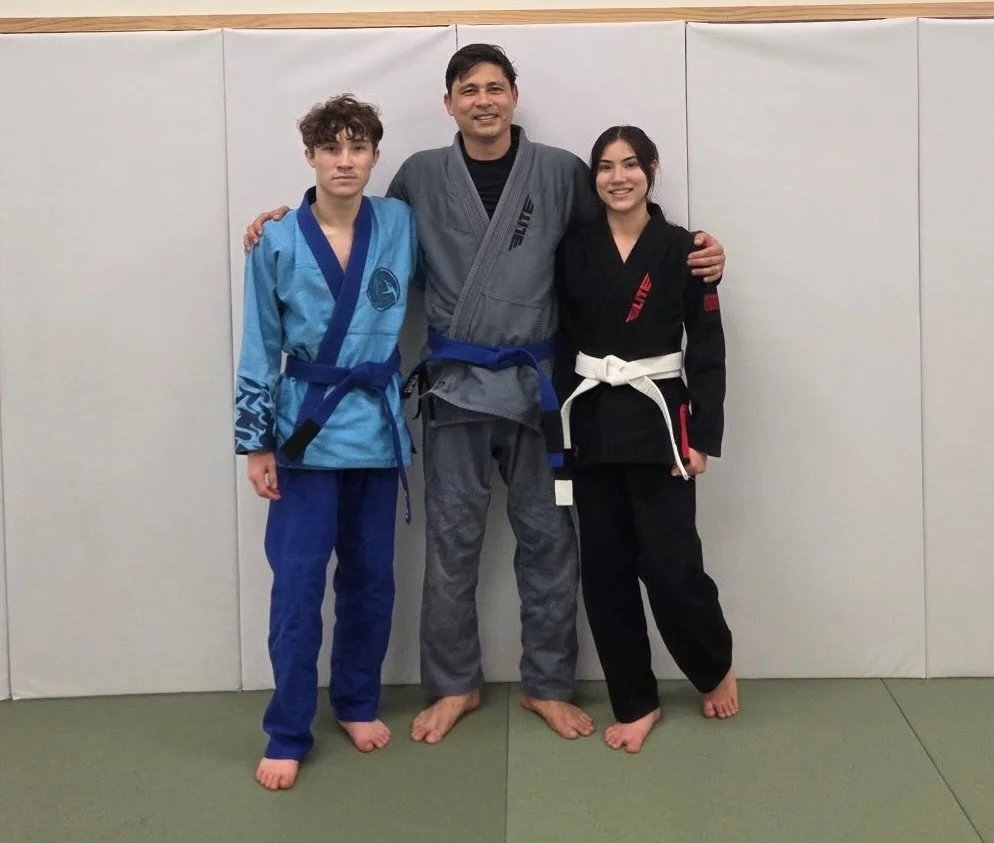
“Owen was the first in our family to begin training when the gym initially opened. He wanted to sharpen his self-defense skills and learn something new. I started a little over two years ago as a way to stay in shape and train alongside Owen. Ava recently joined us, wanting to learn self-defense skills and stay active.
Training together as a family has been a wonderful experience. It has given us the opportunity to spend quality time together while learning something we have all grown to love. We are also grateful for the jiu-jitsu community and the friendships that have become like family at our gym. We genuinely look forward to every class we attend and are excited to see where this journey takes us!” ~ Charles Hensley
The Benefits Go Beyond the Mats
Families who train together tell us the effects show up everywhere.
Kids who see their parents handle frustration on the mat get better at handling it at school. Parents who learn to stay calm under pressure in a tough round find it a little easier to stay calm during a hard week at work or a meltdown at dinner. Brothers and sisters who train together learn to compete without fighting, and to cheer each other on when someone earns a new stripe.
There's also the community. When your whole family trains, the gym becomes a second home. Your kid's friends' parents become your training partners. Belt promotions turn into family celebrations. In a world where many families feel stretched thin and disconnected, that kind of shared community is rare.
And then there's the long game. Jiu Jitsu is one of the few sports that people train for their whole lives. Kids who start at six can still be training at sixty. Parents and kids who start together can keep training together through middle school, high school, and into adulthood. Some of the best training partners you'll ever have might be the ones you raised.
Start Together at Blythewood Jiu Jitsu
If your kid already trains at BWJJ and you've been watching from the bench, this is your sign. Ask any of our coaches about adult beginner classes, and we'll help you find a schedule that fits around your child's.
If you're new to Jiu Jitsu entirely, come try a class as a family. Your kids will train in a program built for their age, you'll train in a class built for beginners, and you'll all go home with something to talk about.
If you want to give it a try, sign up here.
Blythewood Jiu Jitsu is located at:
733 University Village Drive
Blythewood, SC 29016.
Stop by, give us a call, or send us a message. We'd love to meet your whole crew.
The family that rolls together grows together. We'll see you on the mats!